For some time now the IOMICA Measurements and Technical Sub Committees have been working on the idea of water free measurements to replace the current Measurements floatation tank seen at major events.
A document with details of this project is available at the IOMICA web site at:
http://www.iomclass.org/measurement/Wat ... eIOMv3.pdf
Constructive critisism and comments from the IOM class owners, measurers, designers and event organisers are welcome via this forum thread. Please be as specific with your comments as possible, giving solid examples (and empirical data) where possible.
Please say whether you are an IOM owner, official measurer, designer, constructor or event organiser.
Water Free Measurement of IOM
Moderator: Lawrie Neish
-
Roy Thompson
- Posts: 380
- Joined: 15 Nov 2003, 10:50
- Location: ESP 212
- Contact:
Water Free Measurement of IOM
Roy Thompson
"WE DON'T SEE THINGS AS THEY ARE, WE SEE THINGS AS WE ARE" A.N.
"WE DON'T SEE THINGS AS THEY ARE, WE SEE THINGS AS WE ARE" A.N.
-
ralph kelley
- Posts: 68
- Joined: 23 Nov 2003, 17:57
- Location: USA 41
I like the work that has gone into this proposal. A very good effort. Some comments follow.
1. General.
- The concept does not check for the minimum draft. This is fine with me – I see no reason for the minimum draft limit anyway. (Let’s simplify the rules where practical.)
- It might be a good idea to have one company make the gage for use throughout the IOM world so that there is no problem with tolerances. The gages could be mailed around to major regattas as needed.
- Figures 3 and 4 appear to set the gage datum as the aftermost point of the stern. Put differently, one would set up the hull in the gage pressing the boat against the stern limit block. That seems OK for it might be more difficult to set the bow as the datum with the mandatory rubber bumper and variable bow shape.
2. Figures 1, 2. This kind of a gage would appear to work very well. I agree that it is unlikely that these gage points will cause any odd shapes that cause a revolution in hull design.
3. Figure 3.
- The big question in my mind is the selection of the 30 mm and 10 mm gage points. The boats that I see (including mine) don’t float on those lines and generally speaking, float lower than those points. This is probably OK since it would make boats currently built to the 60 mm limit will read within the 60 mm limits.
- These locations are good for all hull designs (including those with slopes to the bow and stern profiles, an important consideration when setting up gage points..
4. Figure 4
- One need not check the counterweight overhang over the bow in a gage like this. It can be easily observed w/o a gage. Accordingly, the boat need not be rigged for this gage session.
- The gage can be simplified and the rudder slot eliminated if one simply rotates the rudder so that the hull can rest on the aft gage. Or, have the rudder removed, since the purpose of the gage is to check the hull draft, not rudder overhang beyond the stern datum.
Ralph Kelley
1. General.
- The concept does not check for the minimum draft. This is fine with me – I see no reason for the minimum draft limit anyway. (Let’s simplify the rules where practical.)
- It might be a good idea to have one company make the gage for use throughout the IOM world so that there is no problem with tolerances. The gages could be mailed around to major regattas as needed.
- Figures 3 and 4 appear to set the gage datum as the aftermost point of the stern. Put differently, one would set up the hull in the gage pressing the boat against the stern limit block. That seems OK for it might be more difficult to set the bow as the datum with the mandatory rubber bumper and variable bow shape.
2. Figures 1, 2. This kind of a gage would appear to work very well. I agree that it is unlikely that these gage points will cause any odd shapes that cause a revolution in hull design.
3. Figure 3.
- The big question in my mind is the selection of the 30 mm and 10 mm gage points. The boats that I see (including mine) don’t float on those lines and generally speaking, float lower than those points. This is probably OK since it would make boats currently built to the 60 mm limit will read within the 60 mm limits.
- These locations are good for all hull designs (including those with slopes to the bow and stern profiles, an important consideration when setting up gage points..
4. Figure 4
- One need not check the counterweight overhang over the bow in a gage like this. It can be easily observed w/o a gage. Accordingly, the boat need not be rigged for this gage session.
- The gage can be simplified and the rudder slot eliminated if one simply rotates the rudder so that the hull can rest on the aft gage. Or, have the rudder removed, since the purpose of the gage is to check the hull draft, not rudder overhang beyond the stern datum.
Ralph Kelley
-
Roy Thompson
- Posts: 380
- Joined: 15 Nov 2003, 10:50
- Location: ESP 212
- Contact:
HI Ralph,
Thankyou for your comments, all very valid.
REQUEST
Would it be possible for you (and anyone else with similar thoughts) to please tell me (in confidence to my personal message mailbox or e-mail) the following information:
-Design and constructor of your IOM
-Height of bows and stern above waterline (please state whether design waterline/actual waterline or both)
-Distance between total length and waterline length and it's distribution at bows and stern (eg, 998mm total legth, 958mm waterline length with 30mm out of water at bows and 10mm out of water at stern).
ie. I want to know, where exactly does you IOM float on the water relative to the bows and stern?
This type of information will be vital in adjusting the properties of the gauge.
Thanks again for your comments.
Thankyou for your comments, all very valid.
This would be very easy to check with another similar longitudinal gauge with a minimum limit bar or with a minimum limit bar offered up below the hull when on the cuurent gauge - if we want to keep the minimum that is...The concept does not check for the minimum draft
I agree it seems like a good opportunity to standardise, but I think it's uneccessary to ship something so bulky around the world. I would like this to be able to be made by almost anyone, the tolerances are easily checked, I am not a super DIY guy and have made a number of these already. Even my homemade gauges are I think much more simple to build and probably more accurate than the majority of water tanks to use if we take into account construction, set up and correct use.It might be a good idea to have one company make the gage for use throughout the IOM world
Yes, that's how I've used it up to now, although the 30mm bow support block was smaller in the original versions and on some models the hull 'fell off' the bow support and the bowbumper only rested on the support - unacceptable.gage datum as the aftermost point of the stern
Exactly, these were the limit used in the Australia test, and seemed to allow almost all current designs thru. What is vital is that it doesn't allow a new superior design to be built and pass measurement with the new gauge. Remember that, with the wide variety of waterline positions/rocker curves etc, it is impossible to mimic the real waterline on so many designs. All we are doing is setting a new reference point from which to measure the new parameters.The big question in my mind is the selection of the 30 mm and 10 mm gage points. The boats that I see (including mine) don’t float on those lines and generally speaking, float lower than those points. This is probably OK since it would make boats currently built to the 60 mm limit will read within the 60 mm limits
Whilst it's possible to check without a gauge, it's also very simple to do at the same time, but you are right in that it would save time and extra work at pre-event measurement. See next comment.One need not check the counterweight overhang over the bow in a gage like this. It can be easily observed w/o a gage. Accordingly, the boat need not be rigged for this gage session.
Yes you are right. But, rudder overhang comes into the total length measurement, which we definitely need to measure at sometime pre-event. The Aus model didn't have a slot, but being made of transparent material and the supports much narrower, it was easy to place the rudder to one side of the support to line up and see if it passed the 1000mm max. The gauge has therfore been specifically designed to replace all of the types of measurements made in the tank in that it measurers total length, hull depth (not draft) and total depth, with the possibilty of adding a minimum depth of 370mm very simply.The gage can be simplified and the rudder slot eliminated if one simply rotates the rudder so that the hull can rest on the aft gage. Or, have the rudder removed, since the purpose of the gage is to check the hull draft, not rudder overhang beyond the stern datum
The boats that I see (including mine) don’t float on those lines and generally speaking, float lower than those points
REQUEST
Would it be possible for you (and anyone else with similar thoughts) to please tell me (in confidence to my personal message mailbox or e-mail) the following information:
-Design and constructor of your IOM
-Height of bows and stern above waterline (please state whether design waterline/actual waterline or both)
-Distance between total length and waterline length and it's distribution at bows and stern (eg, 998mm total legth, 958mm waterline length with 30mm out of water at bows and 10mm out of water at stern).
ie. I want to know, where exactly does you IOM float on the water relative to the bows and stern?
This type of information will be vital in adjusting the properties of the gauge.
Thanks again for your comments.
Roy Thompson
"WE DON'T SEE THINGS AS THEY ARE, WE SEE THINGS AS WE ARE" A.N.
"WE DON'T SEE THINGS AS THEY ARE, WE SEE THINGS AS WE ARE" A.N.
-
Roy Thompson
- Posts: 380
- Joined: 15 Nov 2003, 10:50
- Location: ESP 212
- Contact:
Hii Fred,What happens if the total hull lenght is less than 960mm
If it 'falls through' the gauge then it won't touch the supports and will touch the limit bar, so it will effectively be illegal.
Hi Jens, send me your e-mail via a personal message and we can get in touch.Where can I send the draw or the pictures?
....quite possibly yes, but will it be superior to a current IOM?a boat can be designed with a hull max draft of more than 60mm maybe
Roy Thompson
"WE DON'T SEE THINGS AS THEY ARE, WE SEE THINGS AS WE ARE" A.N.
"WE DON'T SEE THINGS AS THEY ARE, WE SEE THINGS AS WE ARE" A.N.
-
ole_peder
- NOR NCA Officer
- Posts: 140
- Joined: 18 Nov 2003, 12:42
- Sail number: NOR 44
- Design: NOR 44
- Location: NOR 44
- Contact:
I can see the idea of getting rid of the measurement tank, but a measurement tank isn't that complicated to build. Besides a lot of tanks are built already.
The introduction of gauges also requires a rulechange, that describes the measuring gauge. This will restrict the design of the hull by the gauge. The max limit of hull dept and also total dept must be redefined in the rules.
Even if a lot of work is put ino designing a gauge to prevent existing boats to be illegal, they will affect the future design of the IOM.
An example: Very narrow boats, I have heard of boats close to 150 mm wide will need to have a lelatively square midsection to be able to displase 4 kg.
This means they will be more than 140 mm as one of the gauges proposed.
This type of design will in fact gain depth due to the gauge. In a tank this boat will not pass it is too deep.
If a gauge should be used the longitudinal one will effect the hullshape less than the transversal. What we in fact are introducing is a Design WL which designers use when designing. But still you can gain some depth by letting it float on a higher wl.
My conclusion an STRONG recomendation is:
Leave the rules as it is. It works fine and produces a lot of compettitive designs.
We are not able to forsee all the future developments, and trust me they will come. RC yachting has the most creative bunch of sailors and designers in this universe. They will come up with ideas that we never thought was possible today.
Ole Peder Bjørsom
Chairman of NCA for NOR and designer
The introduction of gauges also requires a rulechange, that describes the measuring gauge. This will restrict the design of the hull by the gauge. The max limit of hull dept and also total dept must be redefined in the rules.
Even if a lot of work is put ino designing a gauge to prevent existing boats to be illegal, they will affect the future design of the IOM.
An example: Very narrow boats, I have heard of boats close to 150 mm wide will need to have a lelatively square midsection to be able to displase 4 kg.
This means they will be more than 140 mm as one of the gauges proposed.
This type of design will in fact gain depth due to the gauge. In a tank this boat will not pass it is too deep.
If a gauge should be used the longitudinal one will effect the hullshape less than the transversal. What we in fact are introducing is a Design WL which designers use when designing. But still you can gain some depth by letting it float on a higher wl.
My conclusion an STRONG recomendation is:
Leave the rules as it is. It works fine and produces a lot of compettitive designs.
We are not able to forsee all the future developments, and trust me they will come. RC yachting has the most creative bunch of sailors and designers in this universe. They will come up with ideas that we never thought was possible today.
Ole Peder Bjørsom
Chairman of NCA for NOR and designer
Ole Peder Bjørsom
Chairman NOR NCA
Chairman NOR NCA

water free measurements.
Hi,
A new method MUST have 1+2 features
1) being simpler of course
2) to be compatible with all the possibilities offers by the current rule
ie a legal boat under 2004 must be elligible by the new method.
it is an evidence that you need to relax some specifications to achieve 2)
3)don't create a loophole in the rule. And don't encourage typeforming hullshape.
I think that 2) an 3) conditions are not met with the currents solutions.
I have 3 ioms,
2 on 3 don't pass proposed fig1 gauge due to hull shape.
2 on 3 needs fin modification to pass Fig2 test.
3 on 3 needs modification to be rule optimized with fig 2 , 3 and 4.
Regards
Pierre FRA32
A new method MUST have 1+2 features
1) being simpler of course
2) to be compatible with all the possibilities offers by the current rule
ie a legal boat under 2004 must be elligible by the new method.
it is an evidence that you need to relax some specifications to achieve 2)
3)don't create a loophole in the rule. And don't encourage typeforming hullshape.
I think that 2) an 3) conditions are not met with the currents solutions.
I have 3 ioms,
2 on 3 don't pass proposed fig1 gauge due to hull shape.
2 on 3 needs fin modification to pass Fig2 test.
3 on 3 needs modification to be rule optimized with fig 2 , 3 and 4.
Regards
Pierre FRA32
Pierre Fra 3632
-
Roy Thompson
- Posts: 380
- Joined: 15 Nov 2003, 10:50
- Location: ESP 212
- Contact:
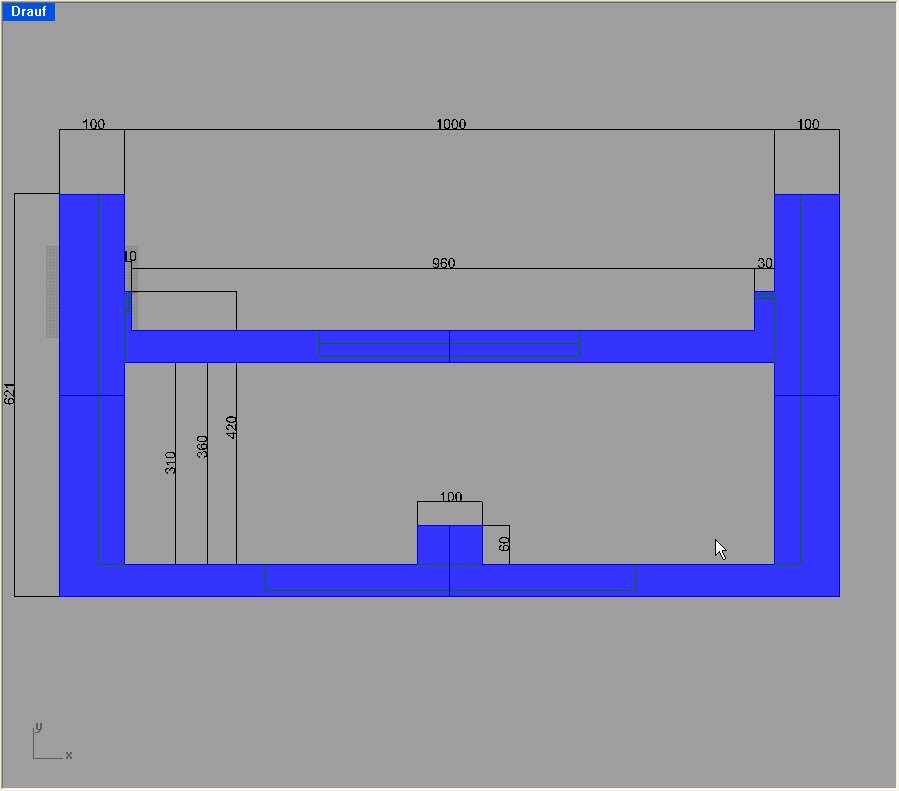
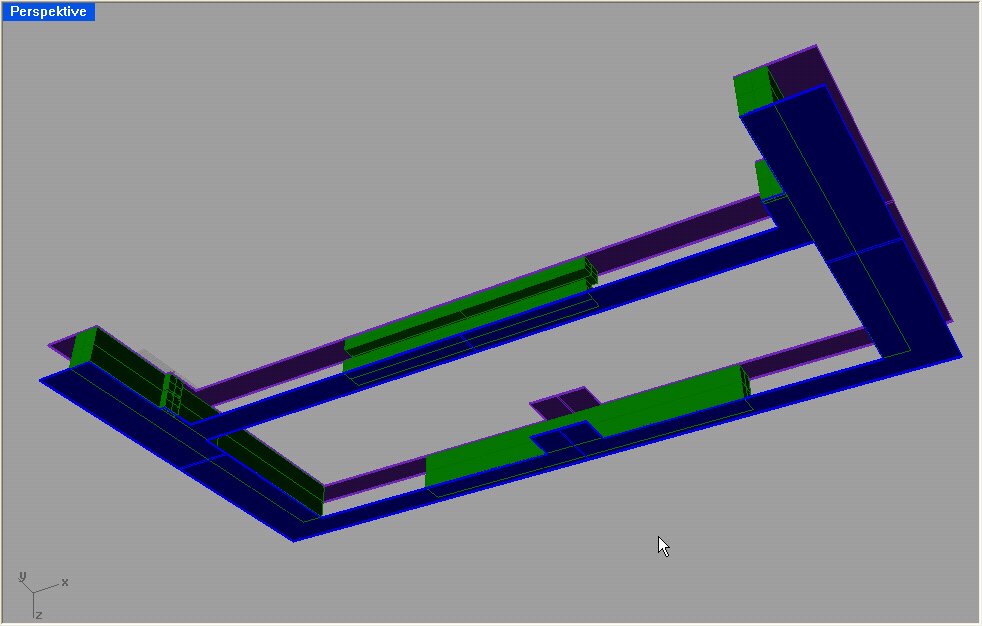
I know that my proposal is a relatively complicated an expensive looking construction and surely we won´t get it (basic material and laser cut) as a gift (Question: Who knows a good sponsor for 20..30 pieces...?). but if we want to have an real alternative to a tank we must go this way.
I tried to use the existing rules (and hope there will be no mistakes).That´s why there shouldn´t be no limitations of hull shapes (think about Michael S.´ boat ) so that such a gauge should only work in the dimensions of length and depth for measuring hull properties. Only the keel (and rudder, o.k.) has draft limitations.
If we want to have a gauge it should be ONE FOR ALL. Now, look:
General construction (all to be read with "cold be", of course):
The gauge consists of 2 (laser cutted) pieces of sheet metal (2mm steel or 3mm aluminium) and several (massive) blocks or tubes between them.
Side view:
The choosed distances are my proposals - especially the waterline length. It could also have a distance of 950mm, however, I´m relatively sure that there will
be only a few existing constructions with a shorter water line and a max hull depth (at the same time).
Left:
The vertical cut at the 10mm full metal block is for checking the rudder and helps keeping the measured boat in the middle of the gauge.
Right:
There could also be a little (2...3mm) vertical cut to fix the hull, but I didn´t drawn it.
Middle:
The 2 upper blocks are for measuring hull depth (60mm) and keel draft (20mm distance). At one end there could be a joiner to fix the distance (also not drawn).
With the "wings" beside the bottom block (distance 60mm) it is possible to check the bulb draft and the min overall depth. To check the last one the "wings" must get a `cut out`(--_--) to be 50mm high in the middle.
I tried to use the existing rules (and hope there will be no mistakes).That´s why there shouldn´t be no limitations of hull shapes (think about Michael S.´ boat
) so that such a gauge should only work in the dimensions of length and depth for measuring hull properties. Only the keel (and rudder, o.k.) has draft limitations.If we want to have a gauge it should be ONE FOR ALL. Now, look:
Jens wrote: Picture 1:
Picture 2:
General construction (all to be read with "cold be", of course):
The gauge consists of 2 (laser cutted) pieces of sheet metal (2mm steel or 3mm aluminium) and several (massive) blocks or tubes between them.
Side view:
The choosed distances are my proposals - especially the waterline length. It could also have a distance of 950mm, however, I´m relatively sure that there will
be only a few existing constructions with a shorter water line and a max hull depth (at the same time).
Left:
The vertical cut at the 10mm full metal block is for checking the rudder and helps keeping the measured boat in the middle of the gauge.
Right:
There could also be a little (2...3mm) vertical cut to fix the hull, but I didn´t drawn it.
Middle:
The 2 upper blocks are for measuring hull depth (60mm) and keel draft (20mm distance). At one end there could be a joiner to fix the distance (also not drawn).
With the "wings" beside the bottom block (distance 60mm) it is possible to check the bulb draft and the min overall depth. To check the last one the "wings" must get a `cut out`(--_--) to be 50mm high in the middle.
Jens Amenda, GER-124
Auf die Dauer... hilft nur SACHSENPOWER !
Auf die Dauer... hilft nur SACHSENPOWER !
Hi All,
Olof Ginström came up with a measurement jig during the winter that we tried on about 10 boats last weekend.
We did not try to solve the waterline problem, simply measure hull length, depth, and overall depth _given a known waterline_.
see www.anderswallin.net
Anders
Olof Ginström came up with a measurement jig during the winter that we tried on about 10 boats last weekend.
We did not try to solve the waterline problem, simply measure hull length, depth, and overall depth _given a known waterline_.
see www.anderswallin.net
Anders
-
Lester
- Posts: 628
- Joined: 14 Oct 2004, 22:29
- Sail number: GBR 105
- Design: Pikanto
- Location: GBR
- Contact:
Hi Anders
Useful, many thanks! It would be really helpful to know if the method *could* replace the water tank. Do you have any data on how the hulls would have measured if you had no knowledge of their waterline? For example, if you assumed the waterline ran from the transom to, say, 25 mm from the stem?VCinfocomms wrote:We did not try to solve the waterline problem, simply measure hull length, depth, and overall depth _given a known waterline_. See www.anderswallin.net
Lester Gilbert
http://www.onemetre.net/
http://www.onemetre.net/
If you look at the full story:Lester wrote:Useful, many thanks! It would be really helpful to know if the method *could* replace the water tank. Do you have any data on how the hulls would have measured if you had no knowledge of their waterline? For example, if you assumed the waterline ran from the transom to, say, 25 mm from the stem?
http://www.anderswallin.net/2006/05/depth-gauge-test/
there are about 8 pictures at the end which show how 5 different designs sit in the gauge.
When we did this test we did not have actual waterlines(measured with tank) marked on the hulls, we just adjusted the sliders so that the reference line was at the stern and approximately at lower edge of the bumper.
For hull-depth the Italikos are quite close to maximum but still well within the rule by 1-2mm .
None of the boats we tried last weekend were close to maximum in depth.
I'm not sure if this method could replace the tank for fundamental measurement, since that would require a class rule change, but if the waterline position was marked or recorded at fundamental measurement then this gauge could speed up event measurement and make it more accurate.
I will try to get pics next weekend with more boats and more designs.
AW
-
ole_peder
- NOR NCA Officer
- Posts: 140
- Joined: 18 Nov 2003, 12:42
- Sail number: NOR 44
- Design: NOR 44
- Location: NOR 44
- Contact:
The method described requires as Anders states that the wateline are known.
This is no problem to solve, use a watertank during initial measurement and record the FF (Freeboard Forwardand) and FA (freeboard aft) as in big boat measurement.
One of the arguments against water tank measurement was accuracy, well the FF and FA will be as accurate as the watertank allows you.
All boats in major events are measured and certified, but still almost every mesaure are checked on all boats, why, we don't trust the certificate. Will we trust the FF an FA recorded at initial measurement? If not we'r back to the tank.
If we change the rules to define a waterline point forward and aft, say 10 mm from the stern and 15 from the stem, I believe this will cover all existing IOM's. Then we can use the method described.
But I am very reluctant to change the rules, we can run into trouble we can not see the reach of today.
I agree that the tank is not very practical, but by this time most countries have made one?
This is no problem to solve, use a watertank during initial measurement and record the FF (Freeboard Forwardand) and FA (freeboard aft) as in big boat measurement.
One of the arguments against water tank measurement was accuracy, well the FF and FA will be as accurate as the watertank allows you.
All boats in major events are measured and certified, but still almost every mesaure are checked on all boats, why, we don't trust the certificate. Will we trust the FF an FA recorded at initial measurement? If not we'r back to the tank.
If we change the rules to define a waterline point forward and aft, say 10 mm from the stern and 15 from the stem, I believe this will cover all existing IOM's. Then we can use the method described.
But I am very reluctant to change the rules, we can run into trouble we can not see the reach of today.
I agree that the tank is not very practical, but by this time most countries have made one?
Ole Peder Bjørsom
Chairman NOR NCA
Chairman NOR NCA
-
Lester
- Posts: 628
- Joined: 14 Oct 2004, 22:29
- Sail number: GBR 105
- Design: Pikanto
- Location: GBR
- Contact:
Hi Ole-Pederole_peder wrote:One of the arguments against water tank measurement was accuracy, well the FF and FA will be as accurate as the watertank allows you
Well, this means there is equally a question of the accuracy of the FF and FA (smile).
Not quite. The certificate is trusted, because it states the legality of the boat as at some specific date in the past. The problem, of course, is that the boat may have undergone maintenance and refitting, and the owner may not have had the boat re-measured to ensure continued conformance to the class rules.All boats in major events are measured and certified, but still almost every mesaure are checked on all boats, why, we don't trust the certificate
Not quite. I think you are correct to say that this will cover all existing IOMs. (Even better, define the waterline 25 mm from the stern and 50 mm from the stem... Do you see where I am going?) The important question is, 'What is the gap between this method and the water tank?' If the method shows that the fin could be lengthened by 10 mm and still be legal, then many owners would want to do that. So this is not a good idea because this causes extra cost that is against the class intention.If we change the rules to define a waterline point forward and aft, say 10 mm from the stern and 15 from the stem, I believe this will cover all existing IOM's. Then we can use the method described
Very true. Two thoughts.But I am very reluctant to change the rules, we can run into trouble we can not see the reach of today
The first is that we need a complete cost-benefit analysis. We already have trouble with the water tank (an awkward item of equipment, difficult to use accurately, not every owner has one, temptation for a measurer to omit tank measurement for a 'known' design and a 'trusted' owner). The water tank method has costs, and benefits, that can be quantified. We can guess that a different method of measurement will also have costs, and benefits, that can be similarly quantified. In the case of 'unknown' future problems, I believe a suitable estimate of probability can be made. Then when we compare the cost-benefit analysis for each method we can make a rational decision...
The second is that, if a change is agreed, it will require vigilance in the first years of operation, and a system of rapid information exchange between NCAs and measurers. If such systems are in place, then I think any problems can be managed and controlled quickly and effectively. For example, during the first year of operation, measurers can be required to supply two sets of hull measures of the boat, one set with the boat measured in a tank, and a second set with the boat measured using the new method. The measurement form would be amended to provide space for this. For any deviation greater than 5 mm, the NCA would send the details to IOMICA for special investigation by the Technical Sub-Committee, and action as necessary. During this period, a boat would only receive a certificate if it passed measurement using the tank. In the second year of operation, the water-free method would be revised, and in the third year a boat could be certificated using either tank or new method.
Well, maybe one tank is OK for a small European country (smile), but a country like USA could do with at least 50 tanks...I agree that the tank is not very practical, but by this time most countries have made one?
Lester Gilbert
http://www.onemetre.net/
http://www.onemetre.net/
-
Roy Thompson
- Posts: 380
- Joined: 15 Nov 2003, 10:50
- Location: ESP 212
- Contact:
Some very brief comments:
If you need to measure the waterline at any stage, you need by definition, water, maybe not a tank as we know it now, but a body of still, fresh, clean water. Comments from measurers in other classes (both r/c and larger classes) have led me to believe that measuring/marking waterlines is a very difficult proceedure to do correctly and accurately. For this reason I would not recommend any method which uses a 'certificated' waterline or attempts to mark a waterline which can (and no doubt will) always change and which implies (a) water (tank) of some sort would be needed at fundamental measurement as opposed to equipment/event measurement. I really don't believe this is the way forward. If we want water free, maybe we need to think completely water free, not just at events. Events where the water tank is needed are really quite rare and possibly only include International and some if not all national championships. Fundamental measurement in many countries is not so rare, occuring many weeks of the year and in many locatyions for countried with a large register of boats. It would a terrible burden on measurers if they needed to have access to tank/water every time they measured a boat for certification -even if the water was a pond you can't gaurantee conditions will be adequate, stable and repeatable just when your 'client' turns up after a 100 mile drive with his new boat.
In my tests with a similar jig, the distance where the bows/stem and transom/stern are supported become critical for a number of reasons: the rubber bow bumper needs to be avoided to remove errors caused by its flexibility, hence you need the bow support quite a long way back on some designs and if the design is very close the the max allowed it could be pushed over, and on more extreme designs with a lot of rocker, even small changes to the support point at the bows/stern can have a relatively large effect on the total depth being tested.
Maybe this isn't as important for the current crop of IOMs, and a few mm's here and there doesn't seem to worry most people - and I tend to agree. I am however concerned that a new breed of IOMs, using the proposed new measurement jigs could appear and make the current global IOM fleet look somewhat redundant. This worry is possibly unfounded, but it would need a serious study by some honest designers to convince me that there is no or very little possibility of this happening.
And finally:
Just my personal thoughts................
If you need to measure the waterline at any stage, you need by definition, water, maybe not a tank as we know it now, but a body of still, fresh, clean water. Comments from measurers in other classes (both r/c and larger classes) have led me to believe that measuring/marking waterlines is a very difficult proceedure to do correctly and accurately. For this reason I would not recommend any method which uses a 'certificated' waterline or attempts to mark a waterline which can (and no doubt will) always change and which implies (a) water (tank) of some sort would be needed at fundamental measurement as opposed to equipment/event measurement. I really don't believe this is the way forward. If we want water free, maybe we need to think completely water free, not just at events. Events where the water tank is needed are really quite rare and possibly only include International and some if not all national championships. Fundamental measurement in many countries is not so rare, occuring many weeks of the year and in many locatyions for countried with a large register of boats. It would a terrible burden on measurers if they needed to have access to tank/water every time they measured a boat for certification -even if the water was a pond you can't gaurantee conditions will be adequate, stable and repeatable just when your 'client' turns up after a 100 mile drive with his new boat.
In my tests with a similar jig, the distance where the bows/stem and transom/stern are supported become critical for a number of reasons: the rubber bow bumper needs to be avoided to remove errors caused by its flexibility, hence you need the bow support quite a long way back on some designs and if the design is very close the the max allowed it could be pushed over, and on more extreme designs with a lot of rocker, even small changes to the support point at the bows/stern can have a relatively large effect on the total depth being tested.
Maybe this isn't as important for the current crop of IOMs, and a few mm's here and there doesn't seem to worry most people - and I tend to agree. I am however concerned that a new breed of IOMs, using the proposed new measurement jigs could appear and make the current global IOM fleet look somewhat redundant. This worry is possibly unfounded, but it would need a serious study by some honest designers to convince me that there is no or very little possibility of this happening.
And finally:
As far as I am aware, boats are not normally certified at events (well, occasionaly yes, but not normally). BOATS HAVE THEIR CERTIFICATE EYED, AND A SIMPLE STAMP IS PLACED ON ITEMS SUCH AS SAILS, KEELS, RUDDERS ETC. Waterline is not measured or marked but the use of the tank in theory checks for total draught, hull draught and total length. Boats, fin/bulbs and rudders are likely to be weighed and sail numbers given a quick look over and that's about it. Occasionaly, depending on the manpower and logistics available, some crude sail measurements are made, but again, they tend to be minimal and nothing compared to the work required for fundamental measurment and later certification of a boat.All boats in major events are measured and certified, but still almost every mesaure are checked on all boats,
Just my personal thoughts................
Roy Thompson
"WE DON'T SEE THINGS AS THEY ARE, WE SEE THINGS AS WE ARE" A.N.
"WE DON'T SEE THINGS AS THEY ARE, WE SEE THINGS AS WE ARE" A.N.
-
Antonio Espada
- Posts: 55
- Joined: 25 May 2008, 12:37
- Sail number: ESP 3
- Club: NAUTICO VILANOVA
- Design: ICEPICK
- Location: BARCELONA-SPAIN
-
Frednatal
- Posts: 23
- Joined: 06 Aug 2009, 14:29
- Sail number: BRA 66
- Design: Xique-Xique
- Location: Natal, RN, BRA
- Contact:
Seeing the IOM Hull Depth gauge v.3R I understand that a boat whith DWL 1.00 m can have a depth more than 60 mm. You d'ont see this in the figure?
If I put a hull with 1.00 m DWL in the gauge the botton of the boat stop in the stern and bow support before the real DWL is in.
I see this. I must be wrong, but I see that if I have a boat with 1.00 m DWL I can design hull depth a litle more than 60 mm.
And the problem of a rule in measure a depth without water is modified to a rule that is:
The depth of the boat measured in a LINE pass in a point 10 mm from stern and 30 mm from the bow not be more than 60 mm.
Well, I think that all boats in present will d'ont have problem with this.
Will be?
Only the boats with less than DWL= 960 mm
If I put a hull with 1.00 m DWL in the gauge the botton of the boat stop in the stern and bow support before the real DWL is in.
I see this. I must be wrong, but I see that if I have a boat with 1.00 m DWL I can design hull depth a litle more than 60 mm.
And the problem of a rule in measure a depth without water is modified to a rule that is:
The depth of the boat measured in a LINE pass in a point 10 mm from stern and 30 mm from the bow not be more than 60 mm.
Well, I think that all boats in present will d'ont have problem with this.
Will be?
Only the boats with less than DWL= 960 mm
Fred Schmidt
http://www.frediom.wordpress.com
http://www.iomdesign.worpress.com
http://footybrasil.wordpress.com/
http://www.frediom.wordpress.com
http://www.iomdesign.worpress.com
http://footybrasil.wordpress.com/
-
Frednatal
- Posts: 23
- Joined: 06 Aug 2009, 14:29
- Sail number: BRA 66
- Design: Xique-Xique
- Location: Natal, RN, BRA
- Contact:
About the Transverse gauge v5.
The lines of a IOM is Absolutely free unless a few dimensions to define a lenght, weight and depth, this is the appeal.
Freedom.
Unhappy when we have a gauge with certain measures naturally there will be a race to explore this.
Notwithstanding you say that these measures not bring possibilitioes to improve design, the race will occur.
If you are right, work discarded.
If wrong, all atual fleet penalized.
When we are going to install a base in the Moon, a primitve tank is so difficult?
When we spend a thousand dollars (or two, or more) for have one IOM, a tank for much people with a better sistem to measure a lenght or a depth is so difficult?
The lines of a IOM is Absolutely free unless a few dimensions to define a lenght, weight and depth, this is the appeal.
Freedom.
Unhappy when we have a gauge with certain measures naturally there will be a race to explore this.
Notwithstanding you say that these measures not bring possibilitioes to improve design, the race will occur.
If you are right, work discarded.
If wrong, all atual fleet penalized.
When we are going to install a base in the Moon, a primitve tank is so difficult?
When we spend a thousand dollars (or two, or more) for have one IOM, a tank for much people with a better sistem to measure a lenght or a depth is so difficult?
Fred Schmidt
http://www.frediom.wordpress.com
http://www.iomdesign.worpress.com
http://footybrasil.wordpress.com/
http://www.frediom.wordpress.com
http://www.iomdesign.worpress.com
http://footybrasil.wordpress.com/
-
Frednatal
- Posts: 23
- Joined: 06 Aug 2009, 14:29
- Sail number: BRA 66
- Design: Xique-Xique
- Location: Natal, RN, BRA
- Contact:
Re: Water Free Measurement of IOM
Well, my friend Ademir Nicaretta, a jurassic lover of IOM, 30 years experience in naval modeling, living in Brasilia, do a IOM Hull Depth gauge v.3R and he put my IOM there.
He say me: "Your IOM dont have depth!". I smile and went to see what he is doing, and I see really that by the gauge my depth was minimal. Seeing well I see that, how my stem have 2 cm under DWL my IOM when in the gauge have a minimum depth.
Why my stem has 2 cm in depth? Because when I do the design I d'ont wanted my stem out of water when in strong winds. like Pikanto and Lintel. Less DWL Lenght, less velocity.
Yesterday when I was looking for my new design and seeing to the transom that have a little elevation from DWL, ocurred me that if I put my future IOM design in the gauge my virtual depth will be more diferent yet.
Why my transom is above DWL? Because the dynamic wave formation, to minimize drag and the cut in the boundary layer.
The gauge is to measure the depth or for what?
He say me: "Your IOM dont have depth!". I smile and went to see what he is doing, and I see really that by the gauge my depth was minimal. Seeing well I see that, how my stem have 2 cm under DWL my IOM when in the gauge have a minimum depth.
Why my stem has 2 cm in depth? Because when I do the design I d'ont wanted my stem out of water when in strong winds. like Pikanto and Lintel. Less DWL Lenght, less velocity.
Yesterday when I was looking for my new design and seeing to the transom that have a little elevation from DWL, ocurred me that if I put my future IOM design in the gauge my virtual depth will be more diferent yet.
Why my transom is above DWL? Because the dynamic wave formation, to minimize drag and the cut in the boundary layer.
The gauge is to measure the depth or for what?
- Attachments
-
- Xique-Xique.jpeg (80.46 KiB) Viewed 87160 times
-
- ljnes-plan-xx.jpg (68.56 KiB) Viewed 87160 times
-
- xx8.jpg (37.33 KiB) Viewed 87327 times
Fred Schmidt
http://www.frediom.wordpress.com
http://www.iomdesign.worpress.com
http://footybrasil.wordpress.com/
http://www.frediom.wordpress.com
http://www.iomdesign.worpress.com
http://footybrasil.wordpress.com/